

-
Pool Filtration: Clean and Clear Water with Pool Salt
A saltwater pool is no longer a luxury. More and more private pool owners are switching from traditional chlorine dosing to salt electrolysis: a system that continuously produces its own chlorine from dissolved salt in the water. The result is crystal-clear, soft-feeling water without the typical chlorine smell and without the need to handle chemical dosing agents. At Nederlandse Zouthandel, we supply high-quality pool salt for all common salt electrolysis systems, in convenient 25 kg bags and economical pallet quantities.

-
How does salt keep your water clean?
The principle is surprisingly elegant. One molecule of salt, an electric current, and some water molecules are enough to continuously produce fresh chlorine as long as the pump is running:
Production. In the electrolysis cell, chloride ions are converted into chlorine gas, which immediately reacts with water to form hypochlorous acid (HClO). This is the active substance that kills bacteria and algae.
Operation. The hypochlorous acid is distributed throughout the pool via the pump and filter lines, oxidising organic material, bacteria, viruses and algae.
Return. After oxidation, chloride remains, dissolving in the water and ready for another round through the cell.
The beauty of this process is that it is self-regulating. As long as there is enough salt in the water and the pump is running, purification remains automatic. The salt concentration changes very little. You only need to add more when you have had to drain water or after heavy rainfall that has diluted the pool.
-
Why choose salt electrolysis?
More and more private pool owners are consciously making the switch for various reasons:
- No stinging eyes or dry skin. The chlorine level remains much more constant than with manual dosing, preventing peaks.
- No lugging buckets. You buy bags of salt instead of packs of chlorine tablets and need to refill less often.
- Soft-feeling water. Due to the small amount of salt, the water feels pleasantly soft.
- No chlorine smell indoors and outdoors. The typical pool smell you notice in public baths is largely gone.
- Lower costs in the long term. The installation requires an investment, but consumption afterward is significantly lower than with classic chlorine dosing.
- Better for swimwear and pool covers. Less bleaching and less wear due to fluctuations in chlorine levels.
For wellness centres, hotel pools and sports complexes, salt electrolysis also offers an important operational advantage: less manual dosing, less inventory management of hazardous chemicals, and a more stable water profile for guests.
-
What type of salt does your pool need?
A salt electrolysis system requires pool salt. This is pure sodium chloride with a purity level of at least 99.8%, without anti-caking agents, iodine, fluoride or other additives. These substances could cloud the water, form deposits on the electrodes, or in the worst case, damage the salt electrolysis cell. Replacing a cell is an expensive affair, so skimping on salt quality is not a wise saving.
Important: never use road salt, table salt, or water softening salt in your pool. Road salt contains impurities, table salt contains additives, and while water softening salt is pure, it is not always free of anti-caking agents.
At Nederlandse Zouthandel, we supply three types of pool salt, in 25 kg bags:
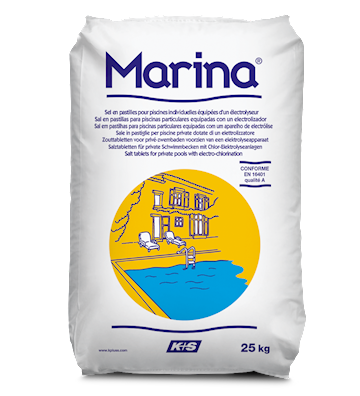
Marina pool salt tablets (25 kg) Compressed salt tablets, suitable for pools and salt electrolysis systems that operate on tablets. The tablets dissolve gradually and are convenient for storage.
Poolsel pool salt granules (15 and 25 kg) High-quality pool salt specially developed for chlorine production via electrolysis. Thanks to its high purity and low sulfate content, this sea salt is extremely suitable for efficient and reliable water treatment.
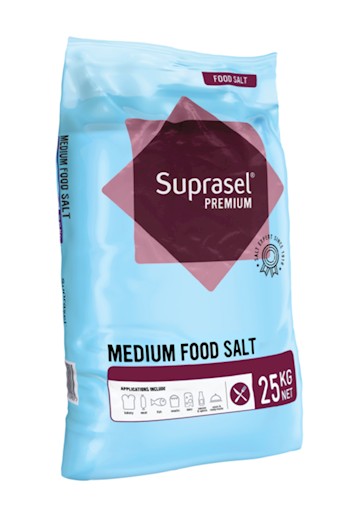
Suprasel pool salt granules (25 kg) Fine, fast-dissolving granules of vacuum salt. The ideal choice for modern salt electrolysis systems that require a quick dissolution time. The salt disappears within a few hours under a lightly rotating pump.
Which variant works best depends on your installation. Check the manual of your salt electrolysis system or ask your pool supplier for advice. Unsure? Give our customer service a call, we're happy to help.
-
How much pool salt do you need?
For the recommended salt concentration of 4 grams per liter (4,000 ppm), you should calculate approximately 4 kg of pool salt per m³ (1,000 liters) of water. The guideline below helps determine the right amount for the initial fill:
- Pool of 20 m³ (for example, 5 x 3 x 1.3 m): approximately 80 kg, or 3 to 4 bags.
- Pool of 35 m³ (for example, 7 x 3.5 x 1.4 m): approximately 140 kg, or 5 to 6 bags.
- Pool of 50 m³ (for example, 8 x 4 x 1.5 m): approximately 200 kg, or 8 bags.
- Pool of 75 m³ (large family or community pool): approximately 300 kg, or 12 bags.
The initial fill is the largest investment. After that, you use significantly less because the salt doesn't "run out" during the purification process. You only need to top up in these situations:
- After backwashing the filter, where water (and thus dissolved salt) is discharged.
- After dilution by rainfall, especially in uncovered pools.
- After topping up with fresh tap water, for example, after a leak or significant water evaporation.
- At the spring opening of the pool, when you restart in the spring.
In practice, an average private pool requires an annual top-up of 25 to 75 kg, depending on the size of the pool and how often you backwash the filter.
-


-
Practical tips for salting your pool
A few points that many pool owners encounter:
- Sprinkle the salt slowly and evenly in the deep end of the pool, with the circulation pump on. Do not pour it into the skimmer or filter, as it dissolves poorly there and can cause damage.
- Only activate the salt electrolysis once the salt is fully dissolved. With tablets, this can take 24 to 48 hours, with granules usually within a day.
- Regularly measure the salt concentration. A simple salt meter or test strip will suffice. In modern installations, the control panel automatically indicates the salt level.
- Also keep an eye on the pH. Salt electrolysis tends to slightly increase the pH. Correct it as needed with pH-minus to keep purification optimal.
- Store your pool salt bags dry. Moisture causes clumping, and although the salt is still effective, it becomes difficult to handle.
-
Order pool salt at Nederlandse Zouthandel
At Nederlandse Zouthandel, you will find Marina pool salt tablets and Poolsel and Suprasel pool salt granules in 25 kg bags. We also offer Poolsel in 15 kg bags.
Orders placed before 3:00 PM on weekdays are shipped the same business day, with fast nationwide delivery.
-
For the initial filling of your pool, you can easily order multiple bags at once, while for annual refills, one or two bags are usually sufficient.
Frequently Asked Questions about Pool Cleaning
-
Does the water taste or feel different in a saltwater electrolysis pool?

With a correct salt concentration of 4 g/l, you can hardly taste it. For comparison: seawater contains about 35 g/l, so your pool is almost ten times softer than the sea. What you do notice is that the water feels softer on the skin, similar to a mild salt bath.
-
Is salt electrolysis really chlorine-free?
No, and that is a common misconception. The purification still works with chlorine, only it is produced by your system itself from salt instead of being added via tablets or liquid. The big difference lies in the constant dosing, which prevents peaks in the chlorine level.
-
Can I just use table salt?
Please don't! Table salt contains anti-caking agents and sometimes iodine or fluoride, which can form deposits on the electrodes and damage the cell. Always use certified pool salt with a purity of at least 99.8%.
-
What is the annual cost of pool salt?
For an average private swimming pool, the annual salt consumption amounts to one to three bags of 25 kg. Count on a fraction of what you previously spent on chlorine tablets.
-
How often should I have the salt electrolysis cell checked?
A well-maintained cell typically lasts five to seven years. Clean the cell annually according to the manual (usually with a diluted hydrochloric acid solution) to prevent scale buildup, and keep the salt concentration within the recommended range.
-
Does salt electrolysis work in an above-ground pool?
Yes, provided you have a suitable salt electrolysis system for the pool's volume. For small above-ground pools, there are compact units that work with a regular garden hose. For larger models, the same principles apply as for in-ground pools.